The AI video generation space is evolving quickly, and much of the conversation has centered on models: which model produces the sharpest output, which handles motion most naturally, which one is fastest. These are reasonable questions, and they reflect the pace at which the underlying generation technology is improving. But they also reveal a gap in how the industry thinks about what it takes to produce professional video content at scale.
At Utopai, we have always approached this differently. PAI was not designed to be another generation model. It was designed to be the production infrastructure that sits around generation models, turning their raw capability into something a creator can direct, revise, and trust across an entire project.
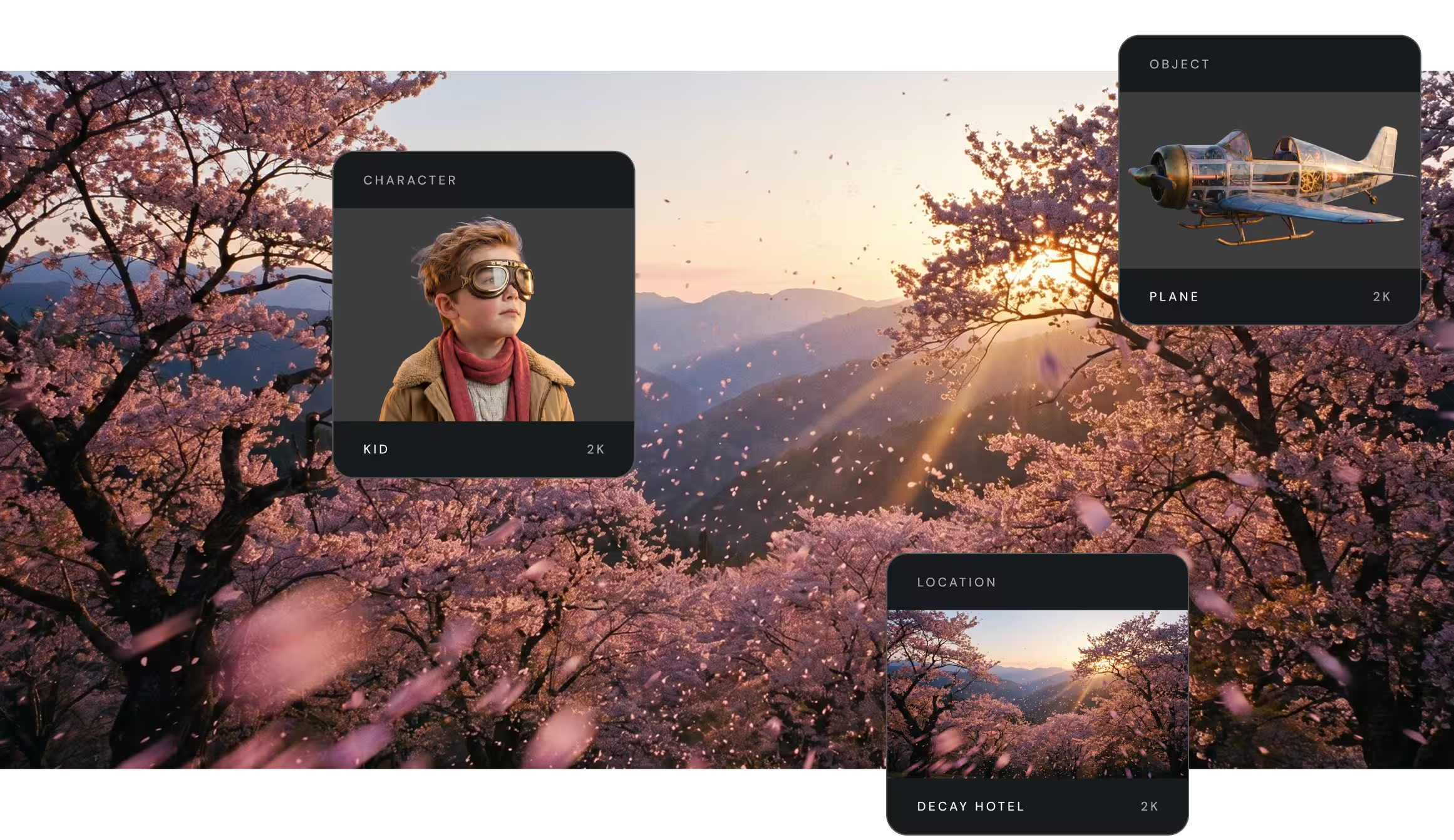
PAI is an advanced agentic system designed to streamline professional video generation through four integrated core components. Powered by our proprietary large language model, the Narrative Analysis Engine deeply decodes scripts to automatically design visual atmospheres, storyboards, and high-fidelity character profiles. To handle complex, long-form projects, the Dynamic Planning Core breaks down tasks and orchestrates the entire production workflow, smoothly transitioning from initial concept to final sequence assembly. Throughout this process, a Persistent Memory Vault ensures strict context retention, allowing the system to instantly recall and reuse established visual assets to maintain narrative and aesthetic continuity across multi-turn workflows or broader IP expansions. Finally, an Adaptive Skills Framework acts as the system's execution hub; it intelligently routes tasks to the most suitable first- and third-party foundation models, while automatically crafting highly optimized prompts that maximize the underlying models' potential to generate exceptional, cinematic-quality images and video.
The generation models that power AI video today are commoditizing. New ones arrive regularly, each improving on the last in resolution, motion quality, or coherence. This is a positive development for everyone working in the space. But a better generation model, on its own, does not solve the problems that professional creators face when they try to use AI at scale.
It does not maintain character consistency across a multi-episode series. It does not carry production memory between scenes so that a creative decision made in act one is still reflected in act three. It does not give a director the ability to revise a sequence while preserving everything that was already working. And it does not integrate into the pre-production, production, and post-production workflows that studios have built their operations around.
These are infrastructure problems, and they require an infrastructure solution. That is what PAI provides. When a new generation model becomes available, PAI does not become obsolete. It becomes more capable, because the orchestration layer, consistency and memory engines, the planning model, and the editorial controls all carry forward. The generation model is an input to the system. The system itself is what makes that input usable for real storytelling.
The practical result is a platform that mirrors how professional video content is actually made rather than how AI demos are typically structured.
A creator uploads a screenplay or story concept, and the planning model breaks it into a production-ready structure. Characters are identified and given persistent visual identities. Environments are established. Storyboards are generated directly from the narrative. Creators can adjust camera angles, lighting, and emotional tone through natural language before any rendering begins.
During production, PAI generates multi-scene sequences—currently up to three minutes long in 4K—while the planning and memory systems ensure continuity across characters, environments, and cinematography. In post-production, multi-turn editing allows creators to revise and refine sequences without starting over. The system remembers prior creative decisions and carries them forward through each iteration.
This is also how we develop our own original content. Utopai Studios operates as an integrated platform where PAI, our production pipeline, and our original IP all reinforce each other. PAI powers the production of original films and series—from original IP to branded entertainment—and is led by experienced Hollywood veterans who transform AI-native entertainment into market-ready IP. That production process generates proprietary data, from assets to creative workflows, that feeds back into PAI and makes the systems smarter with every project. The improved system then enables higher-quality production at greater speed and lower cost, which funds and accelerates the next wave of original content. It is a flywheel, not a one-directional pipeline.
In the era of Generative AI, we envision a future where the cost of media content creation drops dramatically while quality rises at an unprecedented pace. PAI's mission is to accelerate this technological revolution, untethering human creativity and making storytelling a seamless "what you think is what you get" experience.
To achieve this mission, breakthroughs in foundation models alone are not enough. That is why PAI is relentlessly focused on building and refining a multimodal agentic system. By empowering creators to collaborate more efficiently with AI, we aim to augment human capability and increase production efficiency by more than a hundredfold.
Recibir notificaciones
El futuro de la narración, en tu bandeja de entrada.