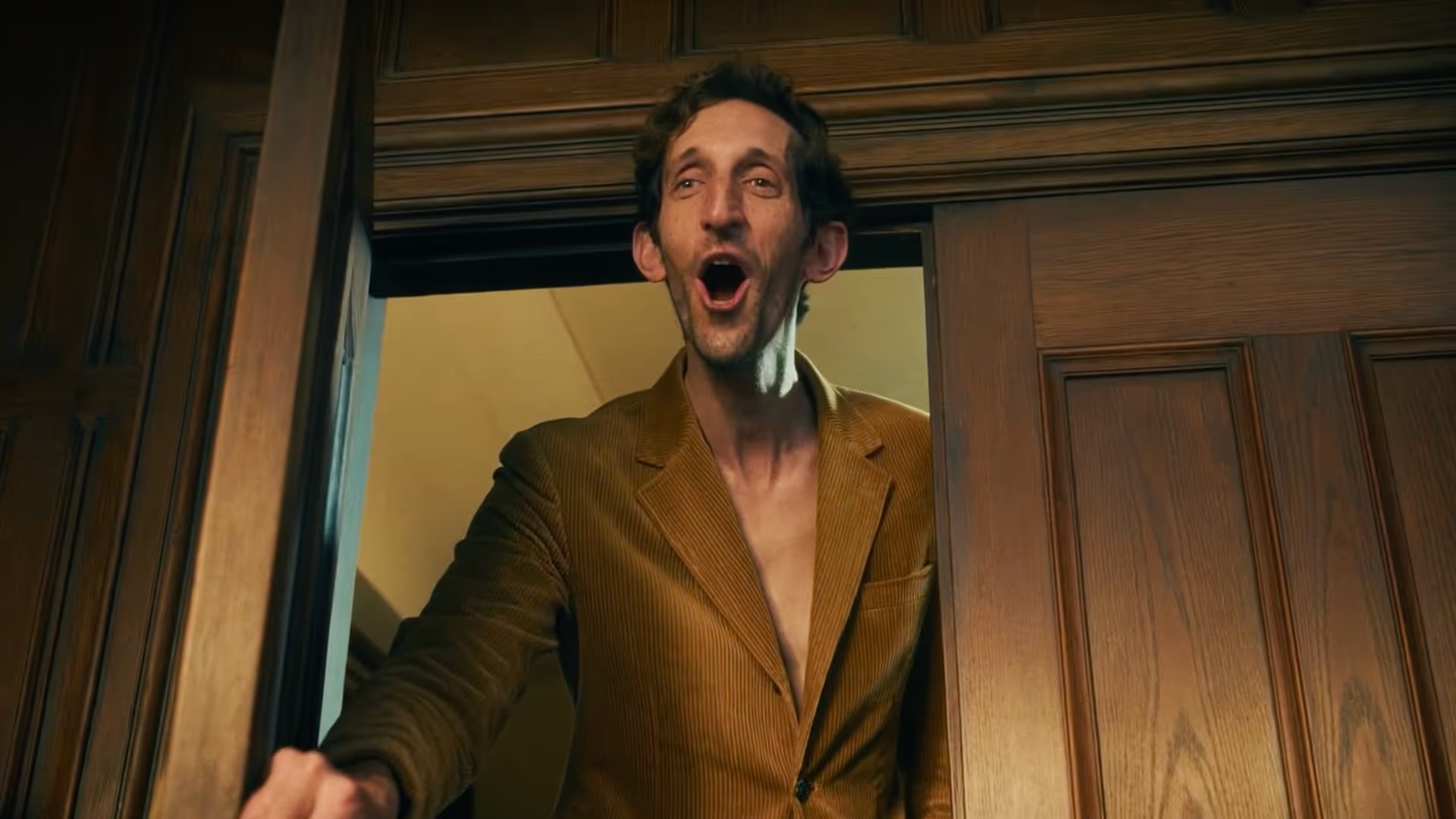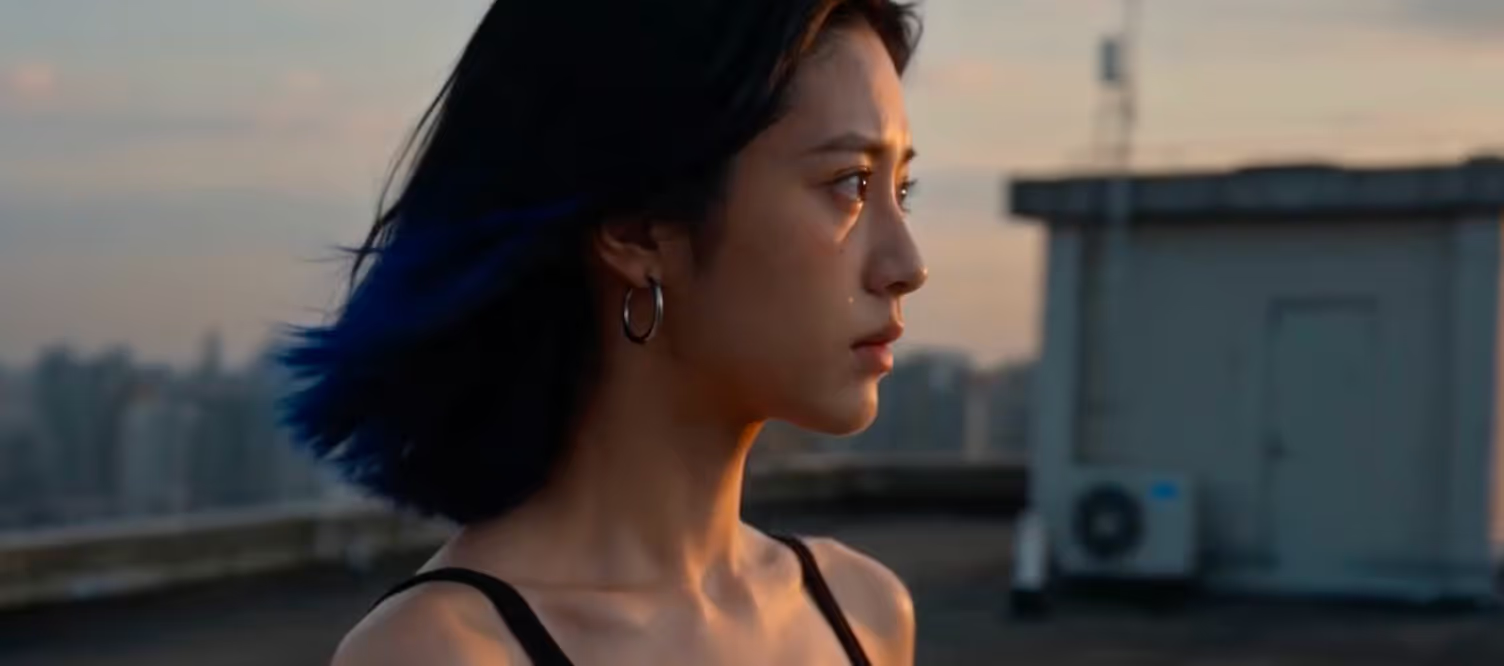
Last week, Chloe vs. History revealed what powers its videos. The AI series that has drawn over 600,000 followers and millions of views by bringing historical moments to life was built on PAI Pro by Utopai Studios.
PAI is not an AI filmmaking tool. It is an entire infrastructure for AI storytelling. And today, we are making that infrastructure available to every developer and creator through PAI Pro. It’s a product surface of PAI built on top of the Skills technology, available through installable skill packages that bring PAI's professional AI video tools, image generation, and cinematic orchestration workflow directly to the coding agents you already use.
If you work with AI coding agents like Claude Code, Cursor, or Codex, you already know skills: modular instruction packages that extend what your agent can do. Install a skill, and your agent gains new capabilities. No context-switching. No separate platform. No workflow fragmentation.
PAI Pro brings AI video production into that paradigm. Instead of switching between your development environment and a separate video generation platform, you can generate, edit, and refine professional-quality visuals and video directly from your terminal or IDE. For creators exploring how to make AI videos or build cinematic content programmatically, this is the most direct path from script to screen.
Ready to upgrade? Install it here:
https://github.com/Utopai-Research/pai-pro
PAI Pro is not a flat collection of generation endpoints. It is a directed hierarchy: an orchestration layer that owns the canvas, the script, and the shape of your project - and beneath it, focused asset-generation skills.
The orchestration layer - how you direct.A canvas-based skill that knows what film you're making. It ingests scripts, breaks them into shot-sized beats, groups nodes into scenes and act structure, and tracks the full project as a directed graph. When your agent talks about "shot 3" or "the morgue scene," the orchestration layer is the index that grounds those references. This is what makesgenerated assets into a coherent film, not a folder of clips.The asset layer - what you make.A set of narrow, single-purpose skills, each emitting one kind of canvas node - visual assets (concept art, character keyframes, scene stills), motion assets (clips and continuations), audio assets (character voices, narration). Each is small and focused. The orchestrator decides how they compose.This is what makes PAI an infrastructure rather than a tool. A tool generates a clip. An infrastructure understands how that clip fits into a scene, how that scene fits into a sequence, and how that sequence serves a story. The hierarchy is what carries that understanding from one generation call to the next.
The number of leaf skills grows with the ecosystem. Sound design, color grading, score - each enters as a new asset generator under the same conductor. The shape stays the same; only the leaf count changes.
Most AI video generator tools available today expose a model endpoint. Send a prompt. Get a clip. That works for isolated content. It falls apart the moment you need what professional production actually demands: characters that look the same across scenes, camera logic that serves narrative, and edits that refine rather than restart.
PAI Pro is different because PAI itself is different. The underlying system was not built as a model. It was built as AI production infrastructure: a cinematic storytelling engine that handles the full production workflow from script to final delivery. That architecture carries through into every skill.
Character persistence. Define a character once. Maintain visual identity across every image and video generation call within a project. The same face, wardrobe, and proportions in every frame.
Narrative continuity. PAI carries context forward. Edits compound toward a creative objective rather than fragmenting it. Adjust the lighting in one shot and the surrounding sequence stays coherent. This is what separates a professional AI video production company workflow from prompt-and-pray generation.
Director-level control. PAI Pro achieves unprecedented precision by allowing you to seamlessly modify input prompts and visual references directly within the orchestration canvas. Instead of wrestling with vague prompt suggestions, you direct camera angles, framing, lens choices, and shot composition as deliberate filmmaking choices - translated by the agent from your prompt into provider-specific cues.
Skills sit closer to the workflow than a raw API. When a developer installs PAI Pro, their coding agent does not just gain access to generation endpoints. It gains understanding of how to use them together. The skill documentation teaches the agent about shot sequencing, character consistency, and multi-turn editing workflows. The agent becomes a more capable collaborator, not just an API caller.
This is what makes PAI an infrastructure, not a tool. A tool generates a clip. An infrastructure understands how that clip fits into a scene, how that scene fits into a sequence, and how that sequence serves a story. This is the same principle that makes productions like Chloe vs. History possible at scale: every generation decision serves the narrative rather than operating in isolation.
For teams evaluating what to consider when choosing an AI video creation platform, this is the distinction that matters. PAI is not a tool you plug into a workflow; it is the workflow.
This is just the beginning. Utopai Studios is building the next major global studio for the AI era, and PAI is the production infrastructure at its center. An integrated AI filmmaking platform built to enable the manufacturing and distribution of cinematic IP at scale, spanning the full lifecycle from development and AI VFX to editing, localization, and global distribution. Powered by veterans from Google, Meta, Adobe, and Princeton, and already adopted by studios worldwide, it is a production system in use today. A system designed to expand opportunity, not restrict it, where more projects get made, creators retain more ownership, and AI video production moves faster than any traditional studio system before it. PAI Pro is how that infrastructure reaches every storyteller today.
PAI Pro is available now. Install it into Claude Code and start building.
https://github.com/Utopai-Research/pai-pro
Currently compatible with Claude Code. Cursor, Codex, and other AI coding agents will be supported soon.
Recibir notificaciones
El futuro de la narración, en tu bandeja de entrada.