A boat needs to feel heavy as it reaches the water. A shadow needs to change when the sun comes out. A mechanical movement needs sound that belongs to the action.
These details matter. They are also among the capabilities Artificial Analysis evaluates when it tests AI video models.
Utopai X is our video generation model inside PAI, Utopai Studios’ production intelligence platform. Artificial Analysis’ launch report offers a closer look at its strengths and how it compares with models including Wan 3.0, Dreamina Seedance 2.5 and MiniMax H3.
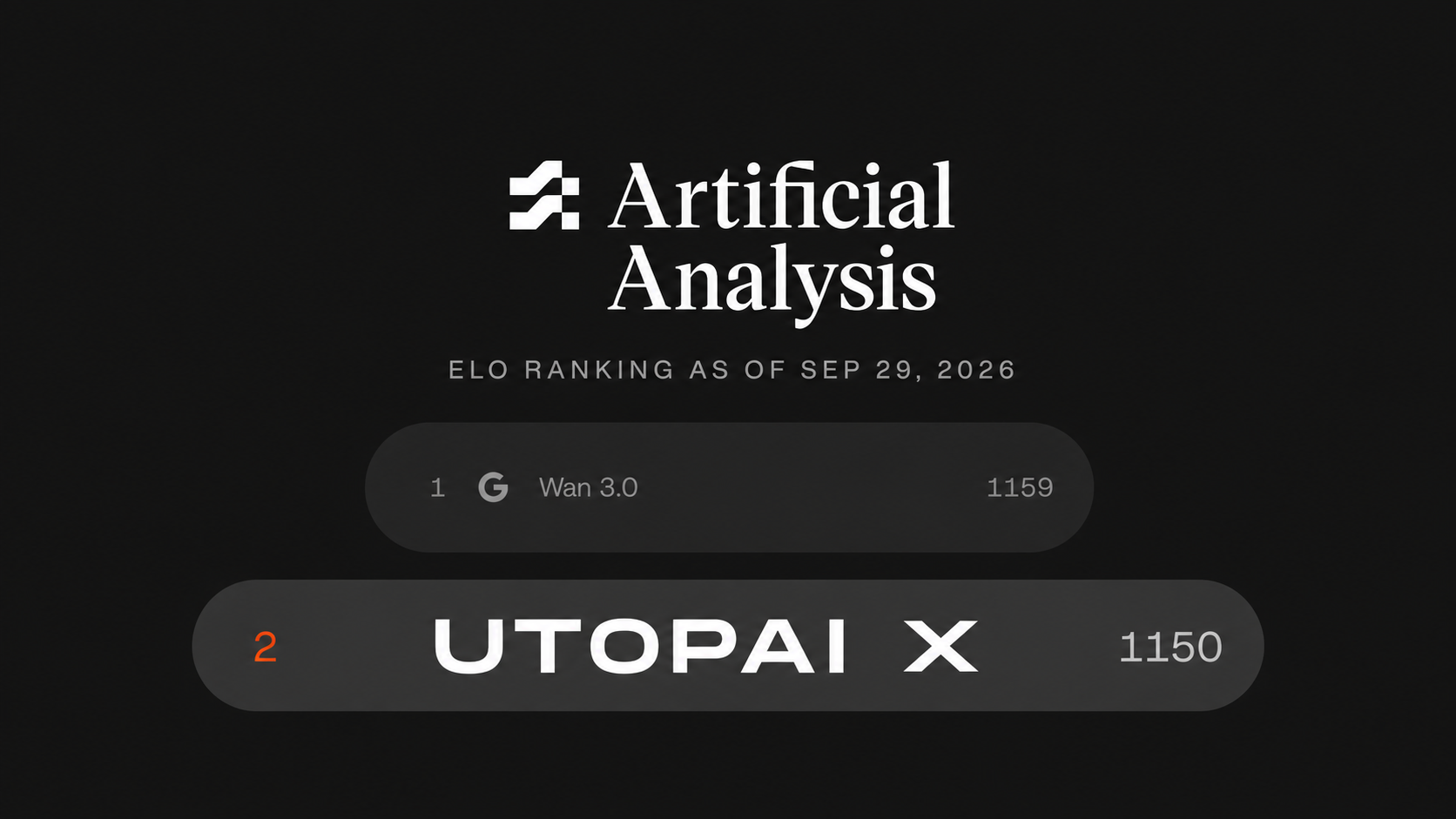
As of October 1, 2026, Utopai X ranked No. 2 on Artificial Analysis’ Text-to-Video Leaderboard With Audio, with an Elo score of 1,150. It was also the highest-ranked model from a U.S.-based company on that leaderboard.
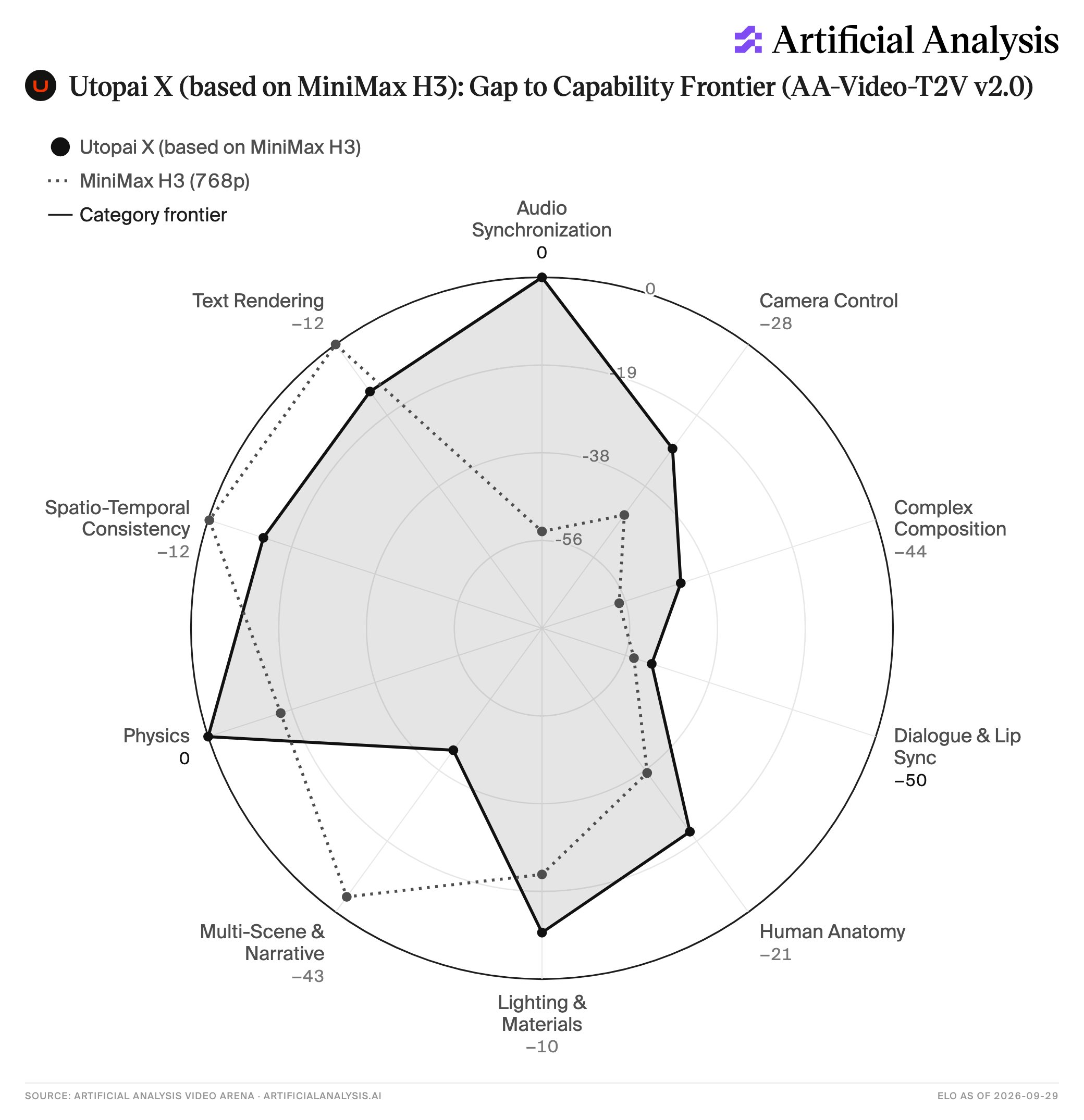
The rankings come from blind human-preference comparisons. In its September 30 launch analysis, AA placed Utopai X first in Audio Synchronization and Physics, with narrow leads over Gemini Omni Flash 1.1 and Dreamina Seedance 2.5, respectively. It placed second in Lighting & Materials and Camera Control, behind Wan 3.0.
Utopai X is post-trained on MiniMax H3. AA found it closer to the leading score in seven of ten capability categories, with the largest gains in Audio Synchronization, Camera Control and Physics.
For us, a model’s capabilities become useful when they help solve a specific creative problem. You might need to explore how an action should play, establish a lighting treatment or develop an animated sequence before committing to a direction.
The examples below are AA benchmark tests. We use them here to explore potential filmmaking applications, with Utopai X, Wan 3.0, Dreamina Seedance 2.5 and MiniMax H3 responding to the same prompts.
A character pulling a boat into the water gives you several things to judge at once: effort, weight, contact and the water’s response. Those same relationships matter in a chase, a creature encounter or a quieter scene built around someone handling an object.
For narrative development and previsualization, you could use a generated shot to explore how an action reads on screen. Does the movement feel convincing? Can you follow what happens? Where would a closer angle help tell the story?
Utopai X’s narrow lead over Dreamina Seedance 2.5 in AA’s Physics category gives filmmakers a specific reason to evaluate it for scenes where physical interaction carries the action.
Physical interaction: compare how the four models handle weight, contact and the transition from land to water. Source: Artificial Analysis.
A product film often depends on small details. Fabric needs to read as fabric. A shadow needs to ground an object. A lighting change needs to reveal the subject in a way that serves the shot.
AA’s plush-toy example tests several of these requirements together. The toy lands on a wooden table while a lamp gradually brightens, with instructions for the light to remain warm.
For commercial development, this kind of task could help you explore a lighting treatment, an object’s entrance into frame or the atmosphere of a proposed shot.
[INSERT VIDEO: aa-toy-lighting-comparison.mp4]
Object motion, fabric texture and a gradual lighting change. Source: Artificial Analysis.
The construction-site example adds another challenge. As sunlight breaks through clouds, the concrete should brighten and the excavator arm’s shadow should become darker and sharper.
That relationship matters when you’re developing an exterior scene or visualizing an architectural space. The light source, surface and shadow all need to respond together.
Changing sunlight and shadow definition at a construction site. Source: Artificial Analysis.
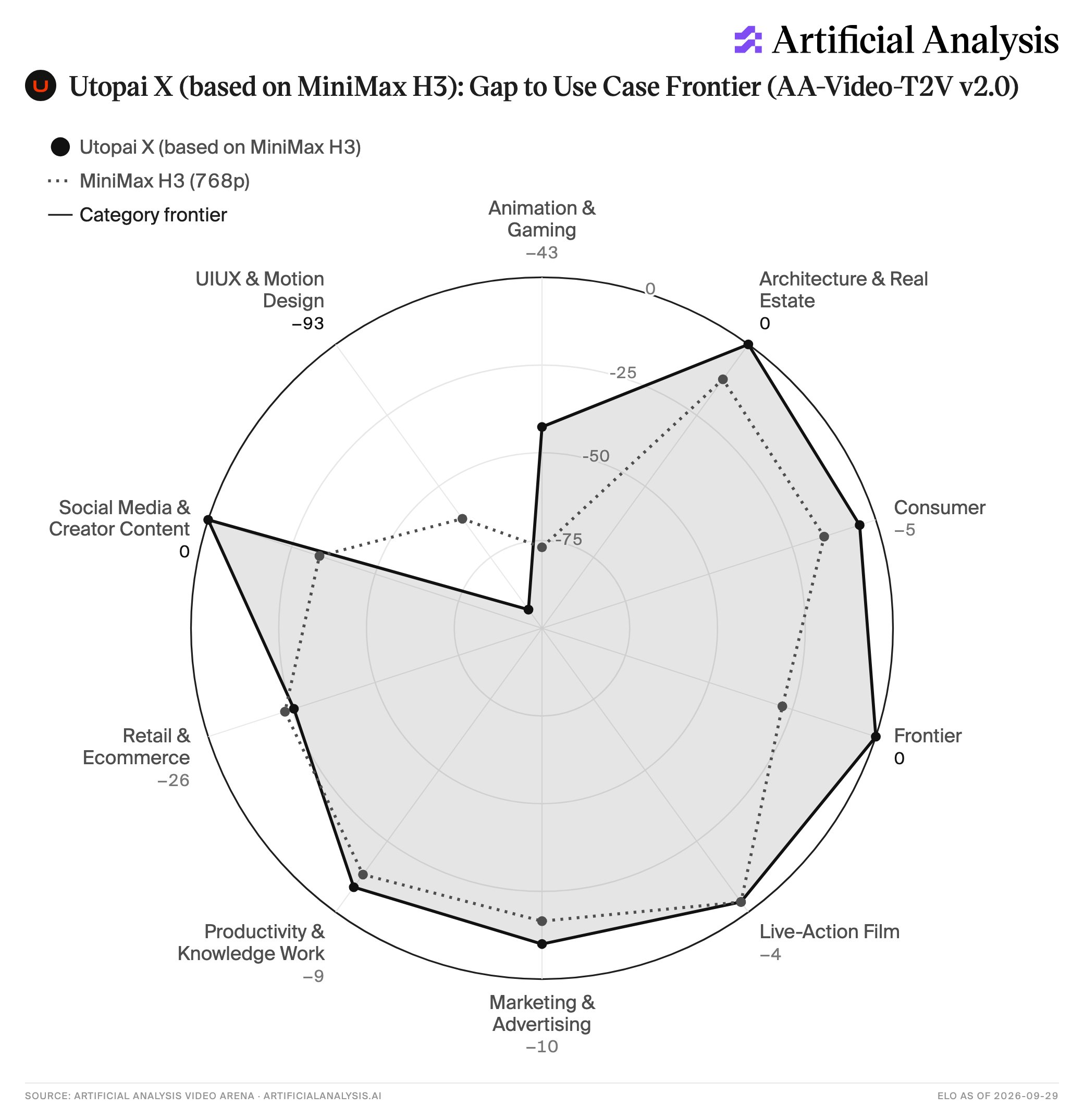
AA placed Utopai X second in Lighting & Materials, behind Wan 3.0. Its use-case analysis also placed Utopai X second in Marketing & Advertising and narrowly first in Architecture & Real Estate.
The robot activation example has a small story to tell. A machine powers up, its systems respond and the sequence takes us inside the cockpit.
You could apply this kind of test when developing an animated short, a game cinematic concept or a science-fiction sequence. It gives you a way to explore the order of reveals, the shift between exterior and interior, and how sound supports the action.
AA placed Utopai X first in Audio Synchronization, narrowly ahead of Gemini Omni Flash 1.1. This category concerns the relationship between sound and picture; dialogue and lip sync are evaluated separately.
Robot activation and cockpit reveal. Watch with sound to compare the audiovisual sequences. Source: Artificial Analysis.
A presenter-led video needs more than an appealing frame. Speakers must take turns, gestures must relate to the explanation and changes in framing must happen at useful moments.
AA’s two-presenter example brings these requirements together through timed dialogue and a whiteboard interaction. For educational content, a branded explainer or a social video concept, it offers a way to assess how each model follows a sequence of instructions.
Utopai X narrowly led AA’s Social Media & Creator Content category in the launch analysis. The individual comparison below lets you examine one example from the evaluation.
[INSERT VIDEO: aa-explainer-comparison.mp4]
A two-presenter explainer with timed dialogue and whiteboard interaction. Source: Artificial Analysis.
Camera movement changes what the audience notices and when they notice it. A reveal can introduce a location. A rotation can make a scene feel unstable. A whip-pan can shift attention to a new action.
The additional AA reel below begins with a construction-wall signage reveal before switching to a stylized rail-yard scene involving camera rotation, falling grain and a whip-pan. These tests offer starting points for evaluating camera direction during shot development.
Additional AA comparisons: a signage reveal followed by stylized camera movement and physical action. The original reel contains both tests.
Different production tasks put different demands on a model. In AA’s launch evaluation, Utopai X led Physics and Audio Synchronization, while Wan 3.0 led Lighting & Materials and Camera Control.
We see those findings as a useful starting point for choosing what to test. The rankings describe performance across an evaluation; your scene still determines whether a particular result works.
The performance, movement, sound and fit with the edit all need a filmmaker’s judgment.
We’re building Utopai X within a film and television studio because filmmaking gives us concrete problems to work toward. A shot needs to communicate an intention. A revision needs to respond to direction. The material needs to work within a sequence.
PAI connects generation with that broader production process. Your script, visual references, assets and earlier decisions provide context for the work, while you direct what to create, keep and revise. Utopai X provides video generation within that environment.
That is the connection we mean by production intelligence. Our ambition is to help build the infrastructure for AI filmmaking, so improvements in model capability become useful creative choices throughout a production.
All comparison videos and charts are credited to Artificial Analysis. Category findings refer to its September 30, 2026 launch analysis; the overall leaderboard position was checked October 1, 2026.
Sources: Artificial Analysis launch thread, capability analysis, text-to-video leaderboard, and Utopai Studios’ launch announcement.
Recibir notificaciones
El futuro de la narración, en tu bandeja de entrada.