
Following its No. 2 text-to-video debut, Utopai X reaches another milestone for video generation developed inside a film studio.
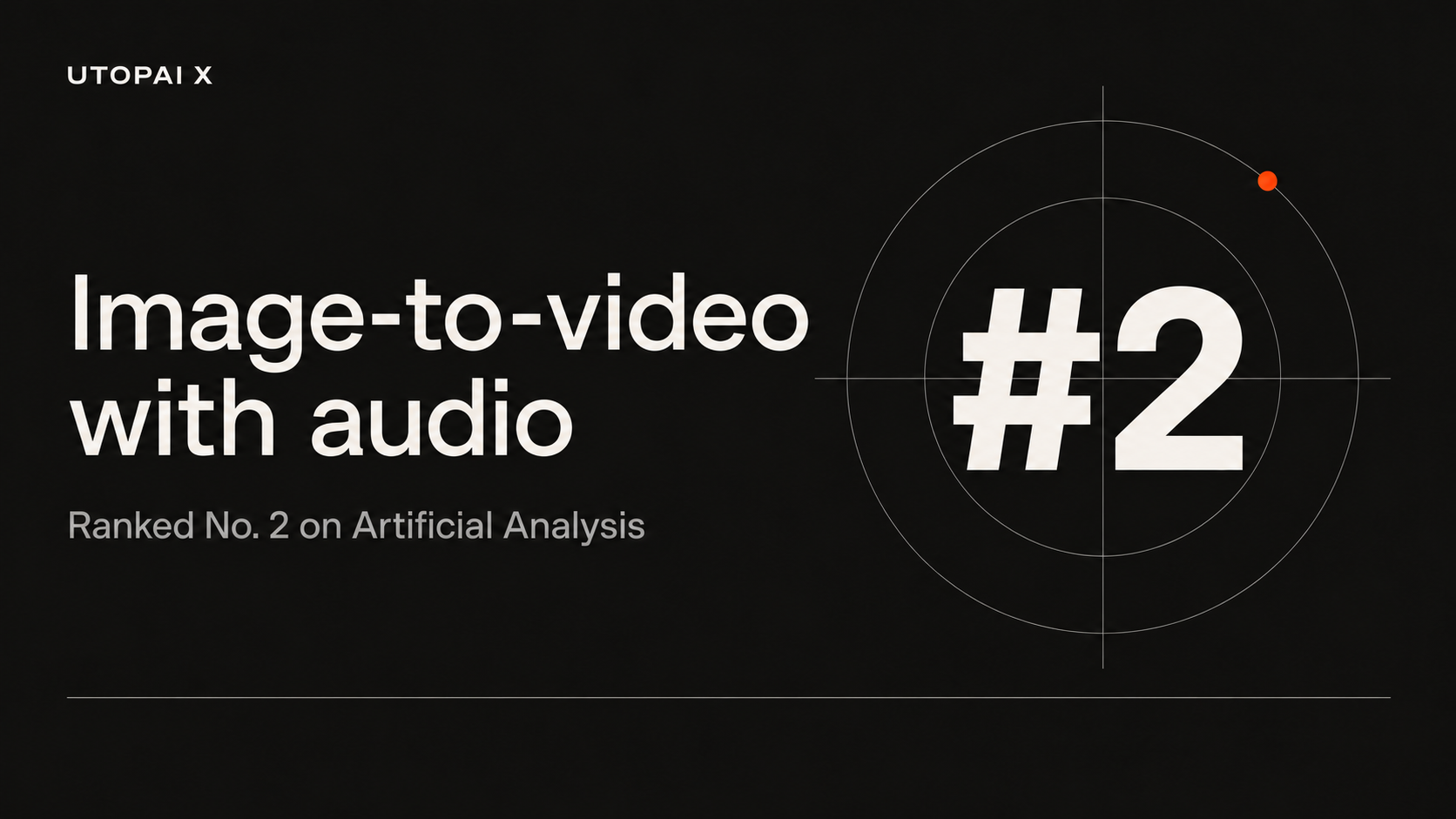
Utopai X, the video generation model developed by Utopai Studios, ranks No. 2 on Artificial Analysis’s Image-to-Video With Audio leaderboard, AA-Video-I2V v2.1, in the October 29, 2026 results. The result follows its No. 2 global debut on the Text-to-Video With Audio leaderboard in September.
For our team, this is progress across two important starting points for making a shot: a written description and an existing image. Each gives filmmakers a different way to communicate what they want to see on screen.
Our work on Utopai X is guided by how well that direction carries through into the resulting footage.
A text prompt can describe a scene, an action or a camera move. An image can establish choices that are difficult to communicate in words alone: a character’s appearance, the arrangement of a set, the quality of the light or the composition of a frame.
Those choices matter. By the time you’re ready to generate a shot, your team may already have spent substantial time developing its look. Image-to-video gives that work a direct role in generation, using an image as the starting point for motion.
The creative challenge is what happens next. A character must move through the scene, a camera move must reveal a believable space, and the lighting and materials need to hold together as the image changes. With audio, sound also becomes part of how the shot is experienced.
When we introduced Utopai X alongside the all-new PAI on September 30, it had placed No. 2 globally on Artificial Analysis’s Text-to-Video With Audio leaderboard, with an Elo score of 1,150 in the September 29 results. It was also the highest-ranked model from a U.S.-based company on that leaderboard.
The latest image-to-video result adds another measure of progress. Artificial Analysis evaluates image-to-video models through blind human-preference comparisons: evaluators compare outputs generated from the same input image without knowing which model produced them. Those preferences inform the Elo ratings.
The two rankings assess different tasks. Together, they help us understand how Utopai X performs when generation begins with language and when it begins with a visual reference.
Rankings reflect the results at the time of publication and can change as evaluation continues.

View the Artificial Analysis image-to-video leaderboard.
When you bring a still image into motion, the details matter. An object needs to move with a convincing sense of weight. Contact should produce a believable reaction. These are the kinds of physical interactions we focus on when developing Utopai X.
We’re also working on how action carries across multiple shots within a single generated video. Starting from an image and written direction, this capability allows filmmakers to explore a sequence of shots within one clip.
Utopai X is developed inside a film and television studio. Our research priorities are shaped by the work our filmmakers need to do and the problems they encounter while doing it.
Productions generate more than finished footage. They produce scripts, character and location designs, shot plans, successive takes and the judgments behind each selection.
Directors, cinematographers and artists assess whether a shot serves its purpose, what needs to change and which details should be preserved in the next pass. That feedback informs model development and evaluation.
Utopai X builds on MiniMax H3 through post-training. Our contribution brings together production data, professional judgment and filmmaking methods.
The results feed back into our productions, where the next round of creative work reveals new priorities for the model and the workflows around it. Each production adds to what the studio can carry into the next.
Utopai X is the video model within PAI, our Production Assistive Intelligence platform. PAI connects scripts, references, shots and takes so filmmakers can develop and review their work in the context of a production.
That context matters because a generated clip is one step in making a film. Your team still needs to judge the performance, compare alternatives and see how the selected take works alongside the surrounding shots.
This is where production intelligence becomes practical: keeping creative decisions connected as a project develops. Creative direction and final decisions remain with the filmmakers.
Ranking among the leading image-to-video models is an encouraging milestone for Utopai X.
Our mission is to give filmmakers the tools to realize their creative vision. That means developing technology that follows creative direction, works within production pipelines and helps teams bring their ideas to the screen.
We will keep building alongside the productions and creatives who challenge us to make the technology better. Their work gives us the next set of problems to solve.
Explore Utopai X and PAI.
Receba novidades
O futuro da narrativa, na sua caixa de entrada.