
How Utopai Studios is building production intelligence for original films and television
Utopai Studios is introducing the all-new PAI, our production intelligence platform, and Utopai X, our proprietary video generation model. Utopai X is the highest-ranked model from a U.S.-based company on Artificial Analysis’ Text-to-Video Leaderboard with Audio, and the No. 2 globally ranked model., with an Elo score of 1,150 in the September 29, 2026 results.
We develop this technology inside a film and television studio, alongside the work of making original productions. That gives our research and product teams access to the decisions behind the footage: the references filmmakers establish, the takes they select and the changes they request. The all-new PAI brings those production methods into a workspace where filmmakers can develop a project and use Utopai X to generate video.
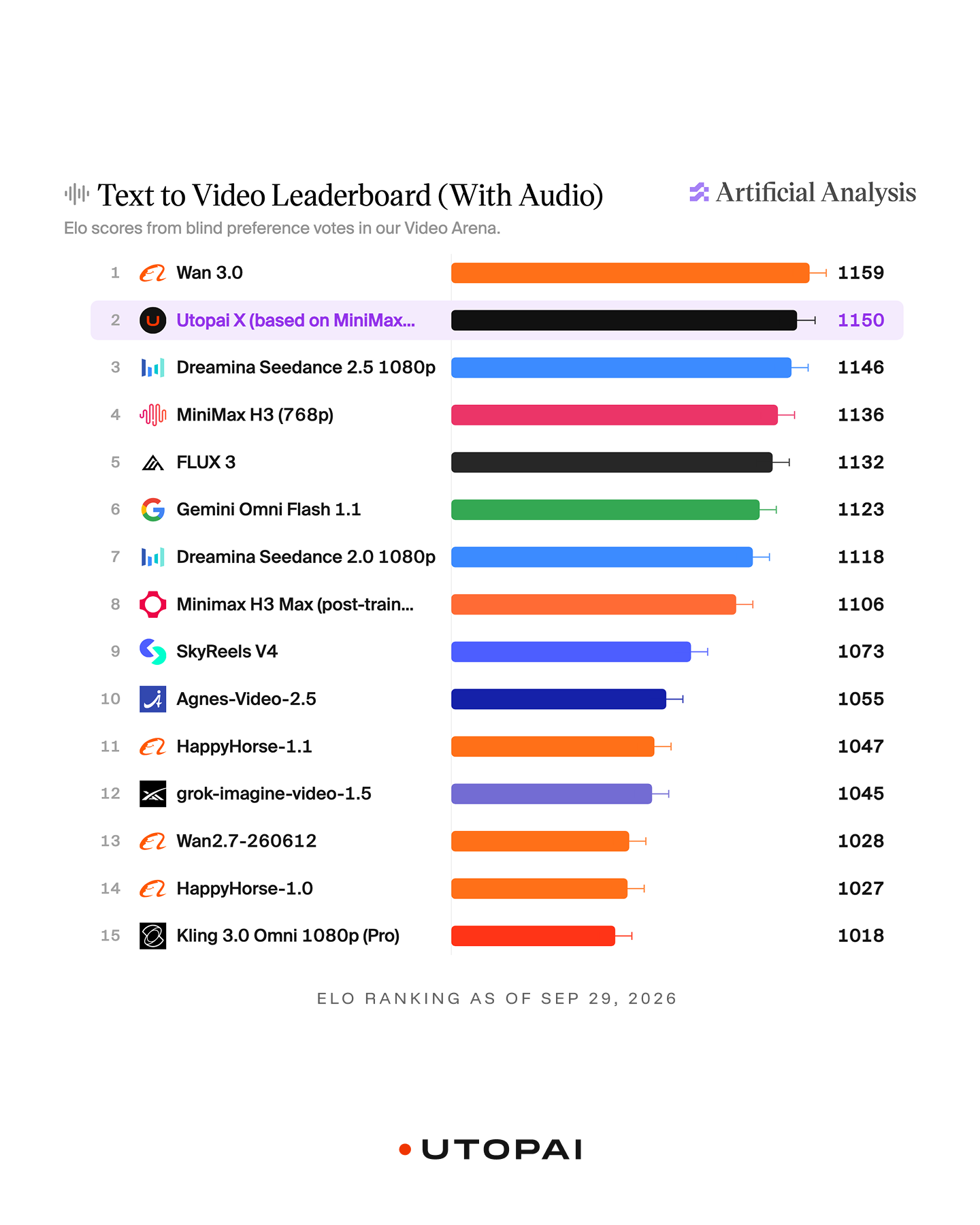
Artificial Analysis evaluates video models through blind human-preference comparisons. Viewers see two videos generated from the same prompt and choose the one they prefer without knowing which model produced either. Those preferences inform the Elo ratings used to rank models within a category.
Utopai X's score of 1,150 places it second on the Text-to-Video Leaderboard With Audio in the September 29 results. It is also the highest-ranked model from a U.S.-based company in that ranking. The result provides an independent assessment of how people respond to its generated footage.
For a studio, evaluation also continues after a clip is generated. Footage has to serve the intended shot, work in an edit and remain useful through revisions. Our development process combines external benchmarking with feedback from people making films.
At Utopai, production intelligence means AI that uses a production's script, assets and creative direction to help carry out filmmaking tasks. The work is grounded in information established for a particular project, including its characters, locations, shot plans and revision history.
In PAI, the script breakdown and production assets remain available while a shot is developed. A filmmaker can compare a new take with earlier versions and return to the references that guided the work. That continuity of information reduces the need to rebuild the brief each time the team generates or revises footage.
PAI provides the environment for this work. Its Production Assistants use project context when helping filmmakers plan and create. Utopai X supplies video generation within that environment when selected by the filmmaker. These roles are connected: the platform organizes the work and the information behind it, while the model produces footage.
Utopai X is Utopai Studios' video generation model, integrated into the all-new PAI. It generates video from text prompts and builds on an existing video foundation model, with further development informed by our studio's production requirements.
Our creative review has identified strengths in reflections and caustics, the concentrated patterns formed when light is reflected or refracted. The review has also highlighted spatial consistency within individual generated clips. These qualities concern how objects and their surroundings hold together in the generated image, including complex interactions between light and surfaces.
We also test and train toward consistency, responsiveness to creative direction and reliable revisions. Those are development priorities for professional filmmaking.
Utopai's productions generate proprietary material, including screenplays, approved character and location designs, shot plans and successive takes. The value of that material includes the professional judgment recorded around it.
Our directors, cinematographers and artists assess which takes work and why others are rejected. Those decisions become training and evaluation signals for the research team. Knowing what was selected and the reason for the choice ties feedback to a production requirement, giving the team a basis for deciding what the model needs to do better.
The research team also uses an internal Elo ranking system to compare model outputs. This process includes human preference assessments and automated voting by vision-language models. Artists participate in the human evaluations, contributing their judgment to the assessment of generated footage.
These internal evaluations support model development, while Artificial Analysis provides an independent comparison based on blind human preferences.
This is one reason we develop the model inside a studio. The research team can learn from how footage is used and reviewed, and production teams can assess changes against the requirements that prompted them.
PAI stands for Production Assistive Intelligence. It is Utopai Studios' production intelligence platform for professional film and television, developed and tested through the studio's own work.
The all-new PAI incorporates filmmaking methods into its workflows and Production Assistants, or PAs. These AI agents use project material to help analyze scripts, develop shot plans and create visual iterations. Filmmakers set the direction, review the results and make the final creative decisions.
The workspace connects the screenplay and production assets with the shots, takes and versions developed from them. A visual canvas supports organization and exploration, while the editing timeline lets filmmakers assemble selected footage into a sequence.
A screenplay can be analyzed and organized into scenes and shots. That breakdown gives the project a structure the filmmaker can review before moving into visual development.
The Production Library organizes character, location and object material. References can be developed and revised as the production takes shape, with versions retained so earlier work remains available. The team can return to an established asset when preparing another shot, keeping the visual brief connected to the project.
Filmmakers can work through guided stages or arrange material directly on the canvas. Both approaches use the project's script and production context, allowing the work to develop in the order the filmmaker needs.
Production Assistants consult project material when helping develop shot plans and visual iterations. The filmmaker can direct this work in plain language and review the results within the workspace.
When the filmmaker selects Utopai X, the model generates footage from text prompts. The resulting takes stay associated with the shot, making it possible to compare alternatives and return to earlier versions. The screenplay and visual references remain available in PAI as the team reviews and revises the work.
Model selection remains with the filmmaker, along with control over generation costs. PAI supports image, video and audio generation through its available models, with Utopai X serving as Utopai's own video model within that broader production environment.
Version history gives a filmmaker a record of how a shot developed. Previous takes remain available for comparison, and selected footage can move onto the timeline for review alongside the surrounding shots.
For Enterprise teams, shared projects and review workflows support collaboration across the production. Approvals are attached to specific versions, so the team can identify the take that received approval as the work continues.
Selected footage can also move into established post-production workflows, including Adobe Premiere and DaVinci Resolve. This connects generation with editorial, where timing and the relationship between shots determine how footage works as part of a scene.
Utopai Studios develops, finances and produces original film and television projects. Our technical work serves those productions, giving us a practical reason to build both a video model and the environment in which filmmakers use it.
We are already applying PAI and Utopai X to our own productions, including The Most Serious Fart, the upcoming animated feature written and directed by Mike Bender. Work on characters, environments and shots gives filmmakers and researchers specific production needs to address together.
Developing the model gives us a direct role in improving generation. Developing PAI lets us work on how filmmakers communicate direction, retain project knowledge and assess the resulting footage. A change can be evaluated within the same production process that revealed the need for it.
Our purpose is to move people through the power of story. We want the knowledge gained on one production to improve the tools and methods available for the next. The all-new PAI and Utopai X bring that investment into our studio's daily work and make it available to other professional filmmaking teams.
Explore the all-new PAI at utopaistudios.com/pai
获取通知
故事创作的未来,尽在您的收件箱。

.png)
